
Humans Are Output Validators
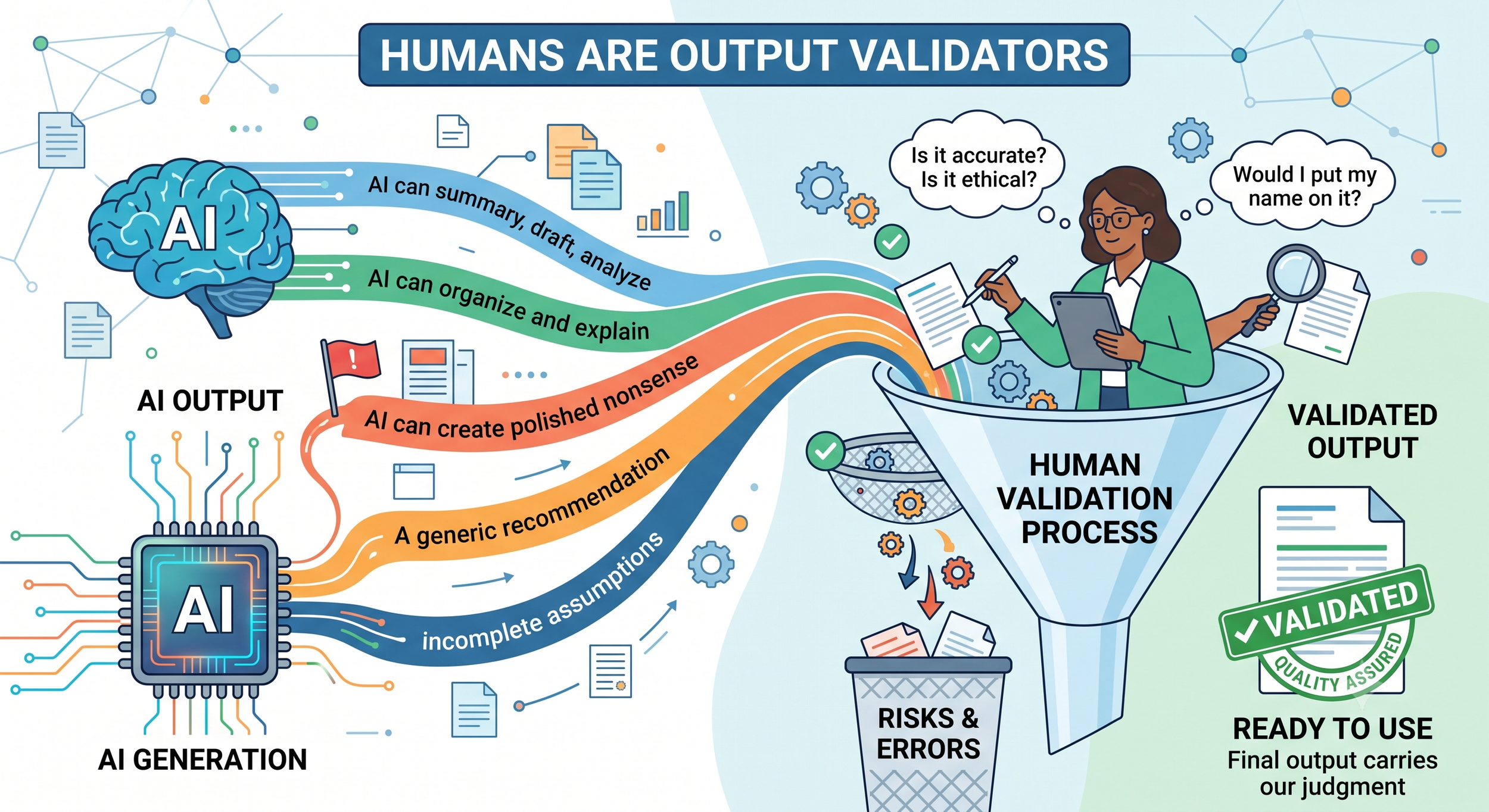
Image Generated Using Gemini by Jeff Nelson
At the recent AGM of CMCs in Calgary, Vincent Vanynh used a phrase that has stayed with me:
Humans are output validators.
That may be one of the most important ideas for understanding how to work with AI and large language models.
AI can summarize, draft, analyze, organize, and explain. It can turn rough ideas into polished output very quickly.
But polished does not always mean correct for the purpose.
When we use AI, our job is not simply to accept the answer. Our job is to judge whether the output is accurate, useful, ethical, practical, and relevant.
AI Is Different From Other Software
Most software tools are fairly consistent. You can predict the results.
A spreadsheet, for example, follows formulas. If the formula and data are correct, the spreadsheet should produce the correct result. If the answer is wrong, the problem is usually in the formula, the data, or the way the spreadsheet was set up.
AI is different.
AI does not simply calculate. It interprets, predicts, organizes, summarizes, and generates. Instead of producing a single fixed answer from a fixed formula, it creates a response based on the information it has been trained on, the instructions it receives, the context it is given, and the patterns it identifies.
That makes AI powerful.
It also makes AI risky.
A weak idea can sound strong. A flawed assumption can be hidden inside a polished paragraph. A generic recommendation can look strategic because it is well written.
The Printing Press Changed Information
History gives us a useful comparison.
The printing press did not just make books faster to produce. It changed how information moved through society. Knowledge could be copied, distributed, shared, debated, challenged, and misunderstood at a scale that had not been possible before.
But the printing press did not make every printed word true.
A printed page could look official. It could travel widely. It could influence people. But humans still had to judge whether the information was accurate, useful, biased, dangerous, or misleading.
AI creates a similar challenge, but at a different level.
The printing press changed access to information. AI changes how information is created and transformed.
AI can take raw material and turn it into a summary, recommendation, email, blog post, strategy document, sales message, research brief, or intentional marketing plan. It does not just distribute information. It reshapes information into something that looks ready to use.
That is why human validation matters.
AI Transforms Information
In a recent discussion with Joanne O’Connell, she made an important point about why AI is different from many other tools.
AI does more than retrieve information.
A search engine retrieves. A database stores. A spreadsheet calculates.
AI transforms.
It can:
Draw from many inputs and patterns
AI can use training data, user prompts, uploaded documents, previous context, examples, and, in some tools, live search or connected data sources.Transform information into usable understanding
AI can summarize, compare, explain, organize, simplify, translate, and connect ideas in ways that help the user understand the subject.Adapt the output for a specific purpose
AI can turn the same raw material into a blog post, email, strategy memo, checklist, proposal, speech, sales message, or decision framework.
That is not just automation. It is a transformation.
But transformation is not the same as truth.
AI can transform strong information into useful output. It can also transform weak information into polished nonsense. It can take incomplete assumptions and turn them into something that sounds confident.
That is why the human role is so important.
AI transforms information. Humans validate the output.
The Human Responsibility
Being an output validator means asking:
Is this accurate?
Is this relevant?
Are the assumptions reasonable?
Is anything missing?
Does this fit the client, customer, market, or situation?
Would I be comfortable putting my name on it?
That last question matters.
If AI helps create the work, we still own the result. The client does not care whether an error came from a person, a template, or an AI tool. The final output carries our judgment.
AI Can Draft. Humans Must Decide.
A simple way to think about AI is this:
AI can draft. Humans must decide.
AI can propose. Humans must choose.
AI can summarize. Humans must verify.
AI can organize. Humans must check logic.
AI can generate language. Humans must protect meaning.
AI can speed up work. Humans must protect quality.
AI is an extraordinary tool, but it is not an oracle. It is a powerful assistant that requires supervision.
The future will not belong to people who simply accept AI output. It will belong to people who know how to question it, improve it, validate it, and apply it wisely.
Humans are output validators.
That may become one of the defining responsibilities of professional work in the AI age.
—————————————
When I reviewed this draft with Vincent, he added, “The human role is about framing the problem, applying judgment, and owning the consequences. AI can generate possibilities, but humans still authorize the outcomes.”
As a summary, I like his statement. Solid.