
Inbound Marketing is Dead
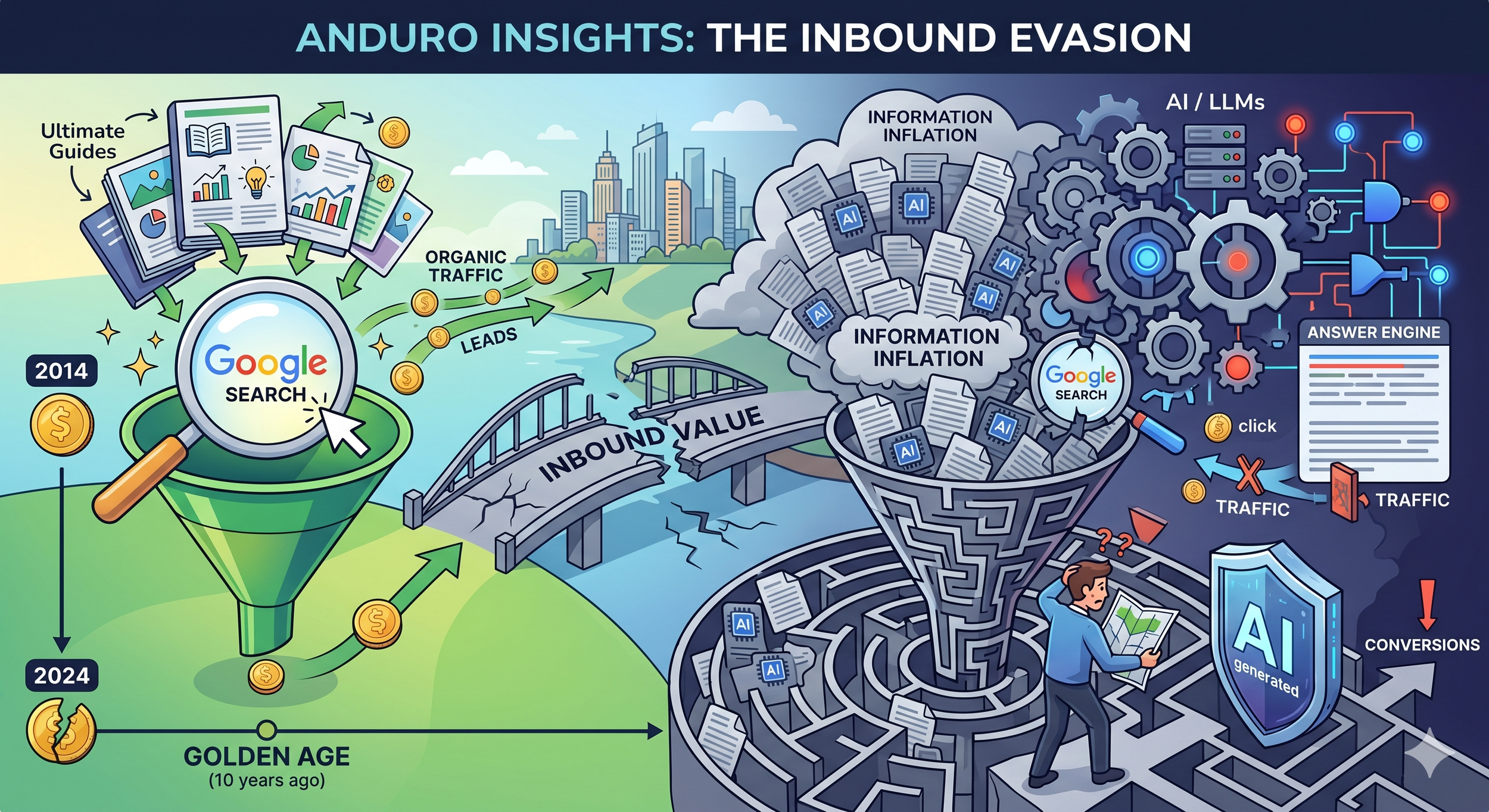
Created by Jeff Nelson using Gemini
Inbound marketing is dead.
Not in theory. Not in textbooks. But in practice, for most companies, it no longer works the way it was designed to.
Until a decade ago, inbound was the dominant playbook for digital growth: create content, rank in search, attract traffic, convert leads, nurture them into customers.
It worked. Exceptionally well.
But the conditions that made it work no longer exist.
What Changed?
1. Content Saturation
Content used to be an advantage. Now it is noise.
Every company publishes blog posts, guides, and videos. Most of it says the same thing. The signal-to-noise ratio has collapsed.
Creating “valuable content” is no longer enough. Valuable compared to what?
Your content is competing against thousands of nearly identical pieces. Most of them are good enough. None of them stand out.
2. Search Has Changed
Search engines are no longer traffic distributors. They are answer engines.
Google increasingly answers questions directly on the results page through featured snippets, AI summaries, and zero-click experiences.
Fewer clicks. Less traffic. Lower ROI.
Inbound relied on traffic as the fuel. That fuel is disappearing.
3. AI Has Commoditized Content
With tools like ChatGPT, content production is no longer scarce.
Anyone can generate articles, guides, and landing pages in minutes.
What used to differentiate companies (their ability to produce content) is now a baseline capability.
The result is simple: more content, faster, with less differentiation.
4. Buyer Behaviour Has Changed
Buyers do not behave the way inbound assumes.
They do not want to enter funnels. They do not want to download whitepapers. They do not want to be nurtured over time.
They want:
Immediate answers
Clear proof
Confidence in their decision
They are informed, skeptical, and impatient.
Trust is harder to earn and easier to lose.
The Real Problem
Inbound marketing did not fail.
Its assumptions did.
Attention is not abundant
Content is not scarce
Traffic does not create trust
Leads do not convert through nurture sequences
If your strategy is built on these assumptions, it will underperform.
What Replaces Inbound?
This is not about abandoning inbound.
It is about replacing it as the core strategy.
1. From Volume to Precision
Stop publishing for broad audiences.
Focus on a clearly defined group with a clearly defined problem.
Your content should feel like it was written for one specific buyer, not everyone.
2. From Traffic to Trust
Traffic is a vanity metric.
Trust is the asset that drives decisions.
Build it through:
Real examples
Clear points of view
Demonstrated experience
3. From Funnels to Systems
The funnel is too linear for how people actually buy.
Replace it with a system that supports:
Discovery
Validation
Decision
These do not happen in sequence. They happen in parallel.
Your marketing needs to support all three at all times.
4. From Content to Insight
Most content repeats what is already known.
Insight is what stands out.
New ways to frame problems
Clear, defensible opinions
Practical, experience-based guidance
Insight builds authority. Content alone does not.
A More Effective Model
Inbound should be repositioned as one component of a broader marketing system.
Content still matters. SEO still matters.
But they are no longer the engine.
They are inputs into a system designed to:
Generate qualified opportunities
Build trust with the right buyers
Support confident decisions
Final Thought
Inbound marketing is dead as a primary strategy.
The companies that continue to rely on it will struggle to generate meaningful growth.
The companies that win will not be the ones who produce the most content.
They will be the ones who are most relevant, most credible, and most intentional.