
The ROAD Framework: A Marketing System
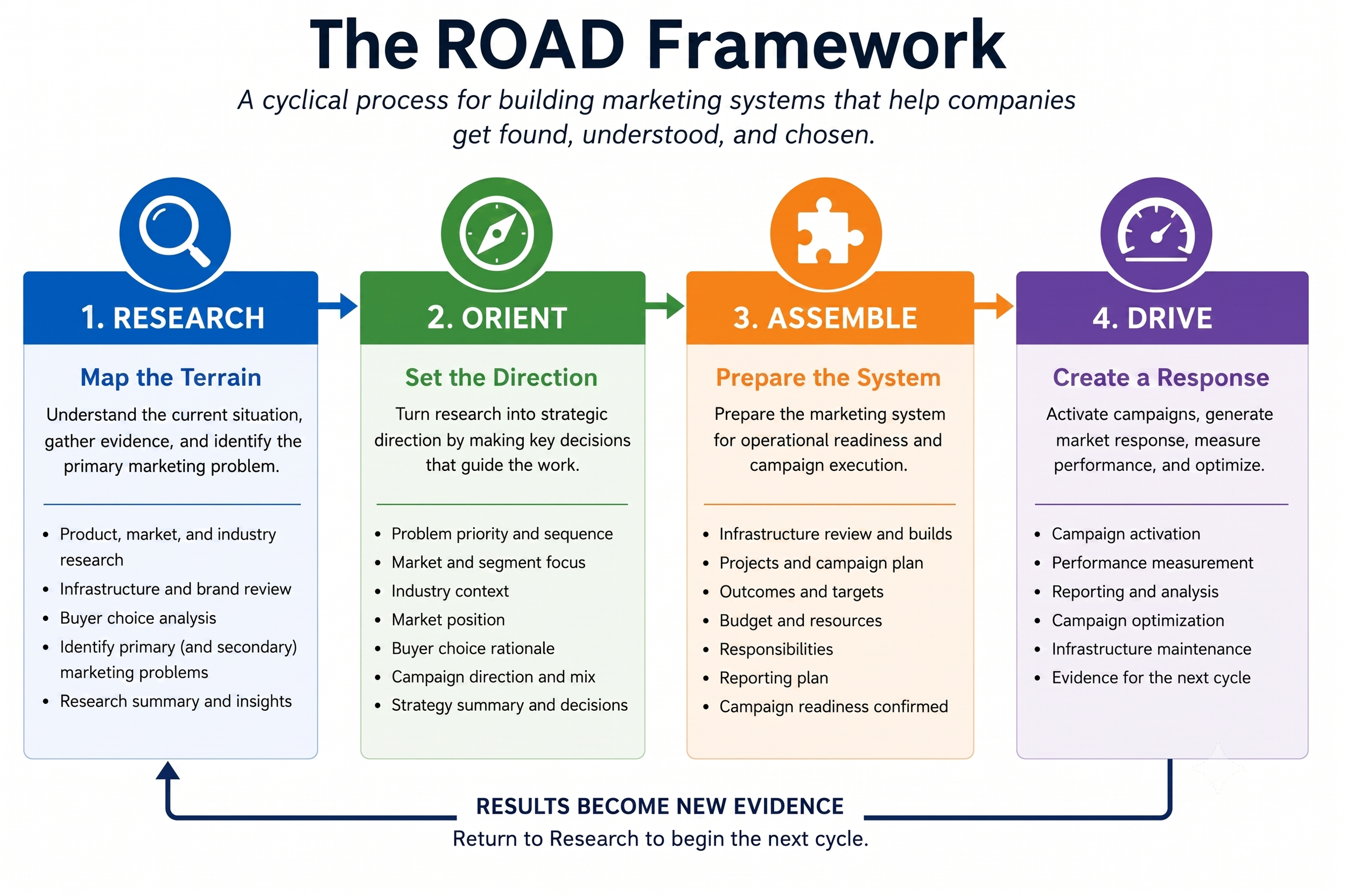
Image created by Jeff Using Gemini
Most companies do not have a shortage of marketing activity.
They have websites, social media accounts, email lists, brochures, advertising campaigns and customer databases. They may also have employees, contractors and agencies working on different parts of their marketing.
What they often lack is a marketing system.
The individual pieces may be useful, but they are not necessarily connected. They may not support the same strategy, communicate the same message or address the company’s most important marketing problem.
That is why we developed the ROAD Framework.
ROAD is a framework for examining a company’s marketing situation, diagnosing its primary marketing problem, orienting strategy, assembling the right marketing system and driving its implementation.
Research: Examine the Marketing Situation
Marketing should begin with evidence, not assumptions about what the problem might be.
Research examines the company, its customers, competitors, the market, marketing infrastructure and the buying process. It considers what the company is trying to accomplish, what it is currently doing, how the market is responding and where opportunities might be.
The purpose is not simply to collect information. It is to understand the company’s marketing situation well enough to diagnose the primary problem preventing growth.
Most marketing problems fall into three broad categories:
Unknown: Too few of the right people know the company exists.
Not Distinct: Prospects know the company, but do not see a compelling reason to choose it.
Not Selected: Prospects show interest, but do not take the next step or make a buying decision.
A company may face all three problems, but Research should reveal which one deserves priority.
This distinction matters because different problems require different solutions. Advertising may help a company that is unknown, but it may waste money if the company is not distinct. A new brand may improve how the company looks, but it will not correct unclear positioning. More leads will not help if the sales process cannot convert the opportunities already being generated.
Conclusion of Research: A diagnosis of the primary marketing problem the company needs to solve.
Orient: Choose the Strategic Direction
Once the problem has been diagnosed, the company can make the strategic decisions that will guide its marketing.
These decisions may include:
Target market
Market position
Core message
Offer
Proof
Route to market
Orient is where choices are made.
A company cannot be everything to everyone. It needs to decide whom it wants to reach, what it wants to be known for and why the right customer should choose it.
These decisions should come before rebuilding the website, developing campaigns or reworking the brand. Marketing assets should express the strategy, not substitute for it.
Conclusion of Orient: A clear strategic direction for solving the diagnosed marketing problem.
Assemble: Build the Marketing System
With the strategic direction established, the company can build the marketing system needed to carry it out.
This includes selecting, developing and connecting the required infrastructure, capabilities, assets, processes, channels and campaigns. Depending on the diagnosis, the system might include a website, search marketing, content, advertising, email, direct outreach, customer proof, sales materials, CRM and follow-up processes.
The goal is not to use every available marketing tactic. It is to assemble the right combination of components for the problem being solved.
Those components must work together. An advertisement should connect with the website. The website should communicate the company’s position and provide enough proof to build confidence. The offer should create a clear next step. The CRM and follow-up process should prevent good opportunities from disappearing.
Assemble also includes planning the campaigns that will activate the system. Each campaign should define the audience, message, offer, channels, timing, responsibilities and intended results.
Conclusion of Assemble: A complete marketing system, including the infrastructure, assets, processes and planned campaigns needed to put the strategy into action.
Drive: Implement the Marketing System
A marketing system only creates value when it is put to work.
Drive is the implementation and ongoing execution phase. It includes launching campaigns, publishing content, managing advertising, conducting outreach, following up with prospects and coordinating the people responsible for each activity.
It also means monitoring performance, learning from the market and improving the system over time.
The most useful measures depend on the original diagnosis. An unknown company may track qualified reach and website traffic. A company that is not distinct may examine engagement and the quality of sales conversations. A company that is not selected may focus on conversion rates, proposals and revenue.
Drive does not build the system. It operates the system, generates market response and reveals what needs to be adjusted.
Conclusion of Drive: Consistent marketing execution, measurable market response and evidence that can be used to improve future decisions and activity.
From Marketing Activity to a Marketing System
The ROAD Framework connects four distinct phases.
Research examines the marketing situation and produces a diagnosis. Orient establishes the strategic direction. Assemble builds the marketing system. Drive implements and operates it.
Each phase provides the foundation for the next. Without Research, the company may solve the wrong problem. Without Orient, its marketing lacks direction. Without Assemble, it has no connected system. Without Drive, the system remains a plan rather than producing results.
The process is also continuous. What happens during Drive creates new evidence that feeds back into Research. The company can then refine its diagnosis, adjust its direction, improve the system and strengthen its execution.
The result is not simply more marketing activity. It is an intentional marketing system designed to help a company get found, understood and chosen.