
Why I Built My Own CRM
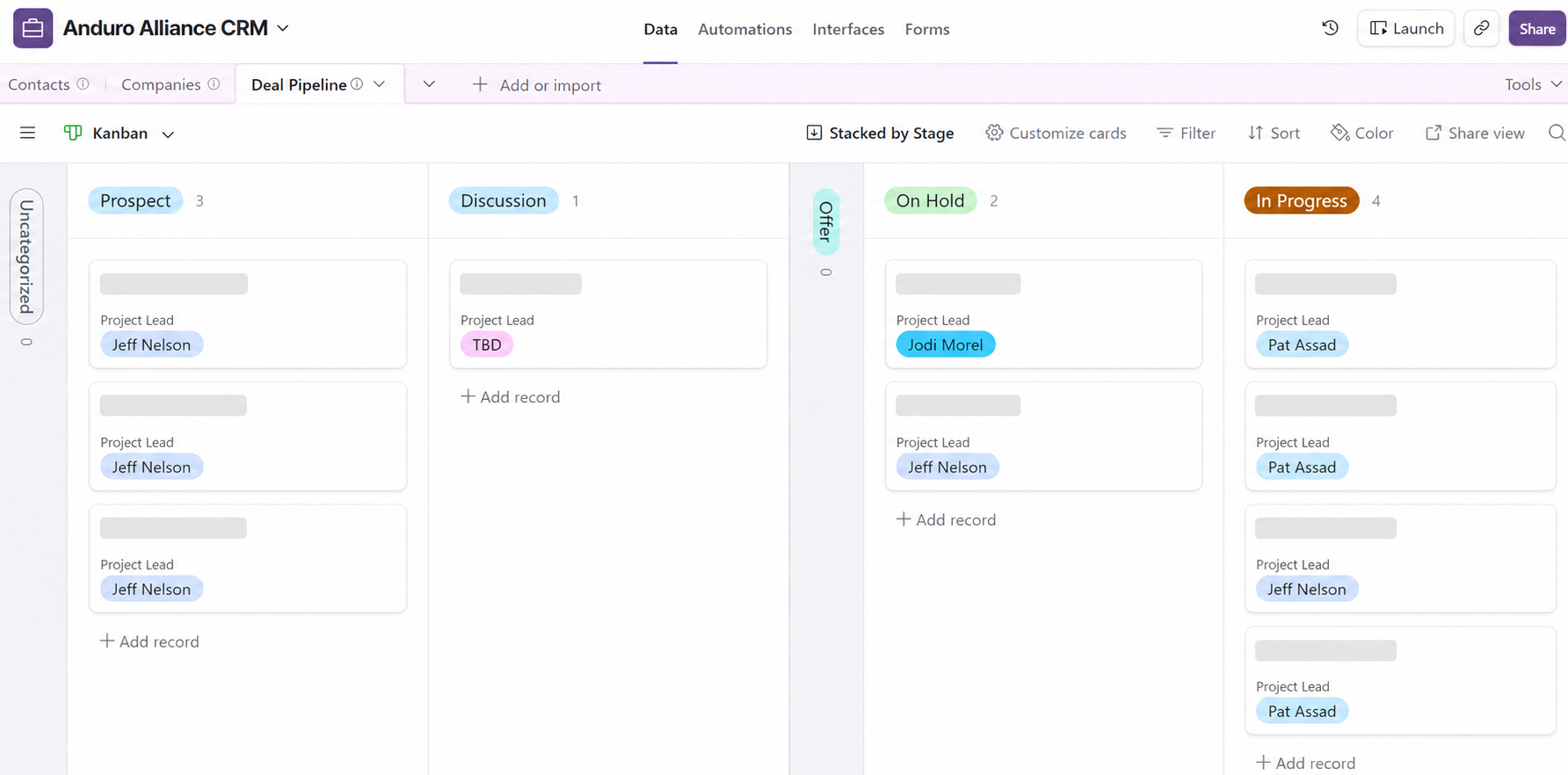
Screenshot by Jeff Nelson. From CRM using Airtable.
Even Small Businesses Need a CRM
Recently, I built a CRM in Airtable.
I have used CRMs for years. I have tested and evaluated many CRMs. I have also complained about CRMs. This time, instead of adapting myself to someone else’s software, I built a CRM around the way I actually work.
That made a big difference.
The Problem: I Wanted to Track Opportunities Better
The main reason I built the CRM was simple: I wanted to track opportunities more effectively.
For Anduro Alliance, an opportunity is not just a name in a list. It is a potential business opportunity that may come from a conversation, a referral, a LinkedIn connection, a past client, a partner introduction, or a marketing campaign.
I needed a better way to see where each opportunity came from, who was involved, what stage it was at, what needed to happen next, and whether it was moving forward or going quiet.
That required more than a contact list. I needed a working model of my business development process.
A custom CRM was the solution.
Why Airtable Worked
Airtable worked because it gave me structure without forcing me into someone else’s assumptions.
Most CRMs come with their own view of how sales should work. They assume which fields matter, which stages should exist, and which reports are important. Sometimes that is helpful, but at other times it gets in the way.
Airtable let me start simply and adjust as I learned. I could add fields, rename categories, create views, connect companies to contacts, connect contacts to opportunities, and organize people by industry, geography, relationship strength, referral source, or next action.
The system could evolve while I was using it. That was the part I liked most.
The Price Point Made It Easy to Start
Another reason Airtable worked for me is that I could start for free.
For a small business, a new CRM is not just a software decision. It is also a time decision, a cost decision, and a behaviour-change decision. When a system is expensive before it is useful, it creates pressure.
Airtable lowered that barrier.
At the time of writing, Airtable has a Free plan for individuals, very small teams, or lightweight needs. The paid plans add more capacity and features. The Team plan is listed at $20 USD per user per month when billed annually. The Business plan is listed at $45 USD per user per month when billed annually.
For now, Airtable is free for me. That may change as usage grows, but I was able to develop the CRM before committing to a larger software cost.
Development and Use Happened Together
I did not build the CRM perfectly and then start using it.
Instead, I built a simple version, used it with real contacts and opportunities, noticed what was missing, and improved it.
As I used the system, I realized I needed better ways to track where a contact originated, separate companies from individuals, improve attribution, and classify prospects by stage in the sales process.
A CRM Is Part of the Marketing System
This project also reminded me that a CRM is not just a sales tool. It is part of the marketing system.
Marketing creates visibility. Sales converts interest into conversations and opportunities. A CRM connects those two things. It helps show whether marketing activity is creating movement in the market.
A good CRM helps answer practical questions:
Did a LinkedIn connection become a conversation?
Did a referral become a qualified opportunity?
Did a company move from a cold prospect to a warm prospect?
Did a marketing campaign produce follow-up actions?
Did we remember to follow up?
Without a CRM, many of these things stay hidden. And what stays hidden is hard to improve.
Key Advantages and Shortcomings
Airtable worked well for me, but it is not perfect. The same thing that makes it valuable, its flexibility, can also create challenges.
Key advantages
Easy to start. Airtable feels familiar because it works partly like a spreadsheet, but records can also be connected across tables.
Free entry point. The free plan made it easier to test the system before committing to a monthly software cost.
Highly customizable. I could create fields, categories, views, and relationships that matched how my business actually works.
Better than a spreadsheet. Companies, contacts, opportunities, campaigns, notes, and tasks can be connected instead of stored in separate places.
Flexible views. I can look at the same information by company, contact, follow-up date, sales stage, campaign, industry, geography, or relationship status.
Clearer thinking. Building the CRM forced me to define what matters: prospects, opportunities, partners, stages, next actions, and follow-up.
Shortcomings
Not a dedicated CRM. Airtable can be used as a CRM, but it does not include all the built-in sales features found in platforms like HubSpot, Pipedrive, Salesforce, or Zoho.
Requires design decisions. The flexibility is useful, but it means I have to decide how tables, fields, categories, and views should work.
Easy to over-customize. Because it is so flexible, it can become too complicated if I keep adding fields or views that I do not actually use.
Reporting may be limited. Airtable can summarize information, but advanced forecasting, attribution, and dashboard reporting may require more setup.
Automation can get complicated. More advanced workflows may require Airtable automations, Make, Zapier, or other integrations.
Costs can rise. Free plans are helpful at the beginning, but paid plans are based on users and features, so costs can increase as the system grows.
Data discipline still matters. Airtable does not fix messy habits. Duplicate contacts, inconsistent names, and missing follow-up dates can still happen.
May not scale forever. For a small business CRM, Airtable can be excellent. For a larger, more automated sales team, a dedicated CRM may eventually make more sense.
For me, the trade-off is worthwhile. Airtable gives me flexibility, but I have to use that flexibility carefully.
The Value Was the Thinking
The biggest value of this project was not Airtable. The biggest value was the thinking that I needed to do during the development.
To build the CRM, I had to clarify which relationships matter, what information I need, what stages a prospect moves through, what should happen next, and what needs to be measured.
These are not just software questions. They are business strategy questions.
That is why building the CRM was useful. It forced me to clarify how business development actually works for Anduro Alliance.
This connects directly to Intentional Marketing. Marketing should not be a random collection of tactics. It should be a system. The product, the market, the message, the channels, the follow-up process, and the measurement model should work together.
The CRM became one piece of that system.
Final Thought
A CRM is not valuable because it stores names and email addresses. It is valuable because it helps a company remember, follow up, measure, and improve.
For me, Airtable worked because it let me build the system I actually needed, use it as I developed it, and improve it as I learned.
Don’t just buy a CRM.
Build the system you actually need.
Contact me if you have questions:
Mobile: 403-703-2247
Email